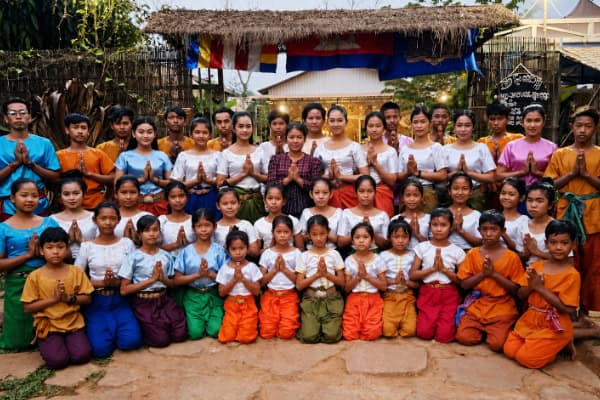
Welcome to the Village of Kanell

Show Programme

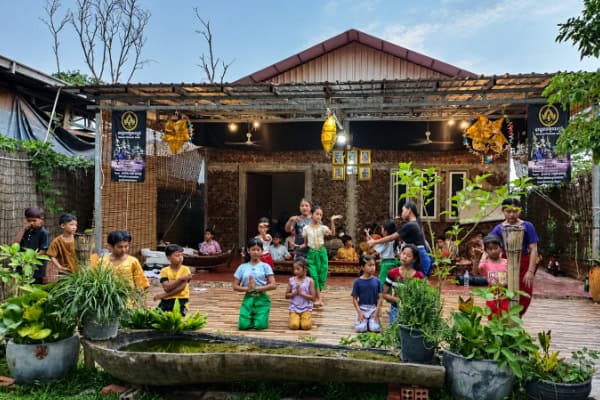
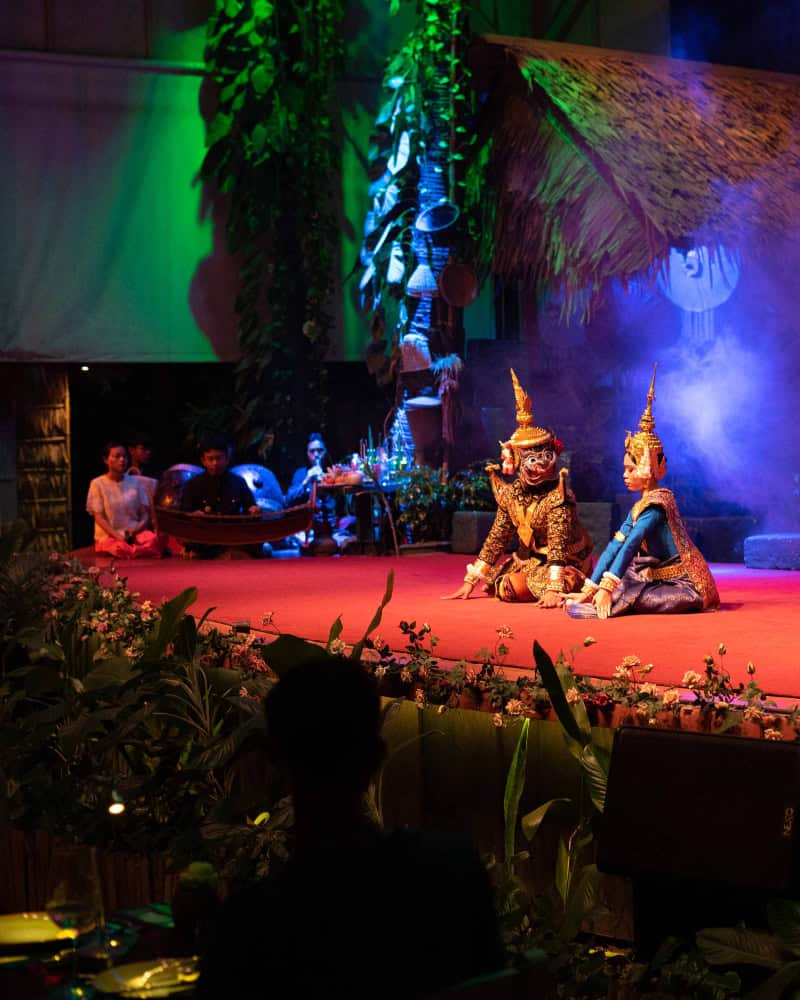
Once upon a time, there were two dancers from a traveling company getting lost in the jungle. They then reached a small fisher’s village of Kanell, located nearby the river.

To get on with their journey, the two dancers had played the Mekhala dance, known as the story of the lightning’s origin. Because of that, a real storm took place and from there, the world of men and Gods started to telescope.

Some monkeys who had been following the two dancers began to invavillage, so Bokators, the peasant warriors tried to chase them away. Since Kanell’s doors were being protected by Bokators, the monkeys decided to build a bridge across the river between their jungle and the
village. Unfortunately, the Gods interfered.

The Goddess of the river destroyed the bridge, which perturbated her water world. Meanwhile, Hanuman also tried to help the monkeys in their fight against the fishes.

Between dances, fights and jokes of the monkeys, here comes Kanell in a surprising whirlwind!
Kanell Show Program Music Instruments
TRADITIONAL SOUNDS

Khmer Traditional Music

Experience the rhythm and soul of Cambodia through Khmer Traditional Music, where drums, gongs, flutes, and ancient melodies guide the atmosphere of the performance. Rooted in heritage and storytelling, each instrument adds its own voice to the scene, creating moments of energy, emotion, and cultural beauty that bring the world of Kanell to life.
Read More
Kanell Show Program Music Instruments
LEGEND OF LIGHTNING

Mani Mekhala Dance

The Mekhala dance is a myth about the origin of thunderstorms and lightning. 2 students, the giant and Mekhala studied with the same master. After the training, the teacher gave 1 magic object each : the giant got an ax and Mekhala received a bright crystal ball, which is very powerful and brilliant. The giant was very envious and wanted the crystal ball, so he tried to throw an ax to kill the Mekhala, while Mekhala threw back the glass to resist and the 2 objects were colliding and became thunderstorms and lightning flashing up on the sky. At last, the giant had lost, gave up and accepted his defeat.
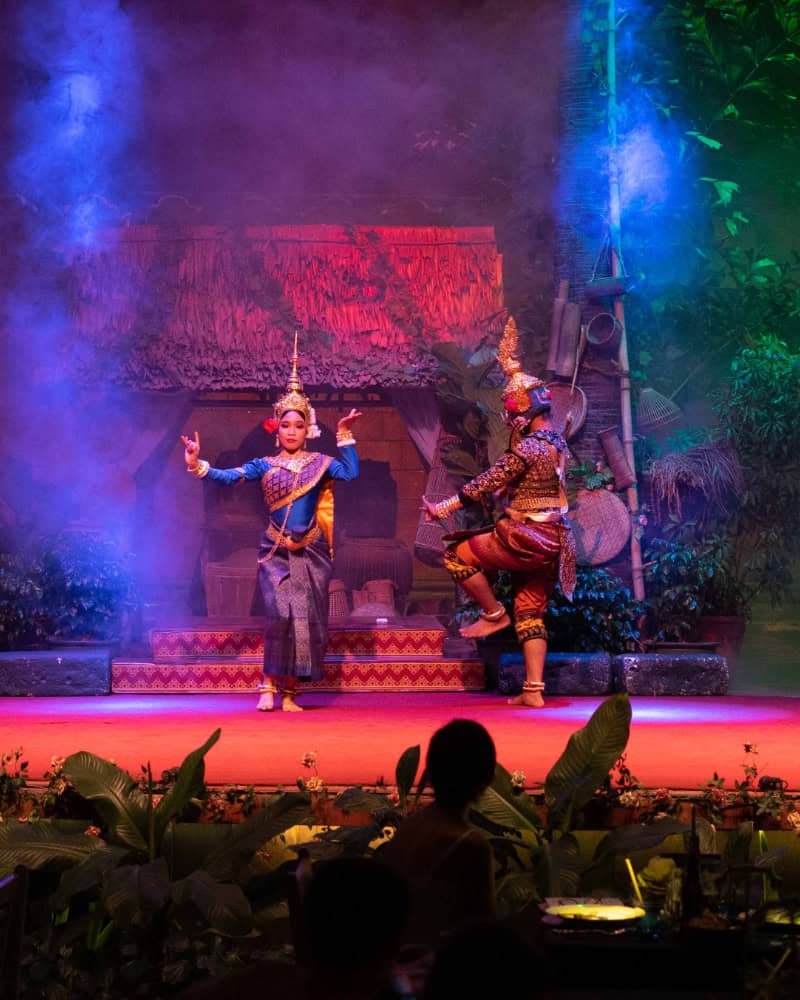
Kanell Show Program Mani Mekhala Dance
Kanell Show Program Apsara Dance
Kanell Show Program Fishing Dance
RIVER LIFE

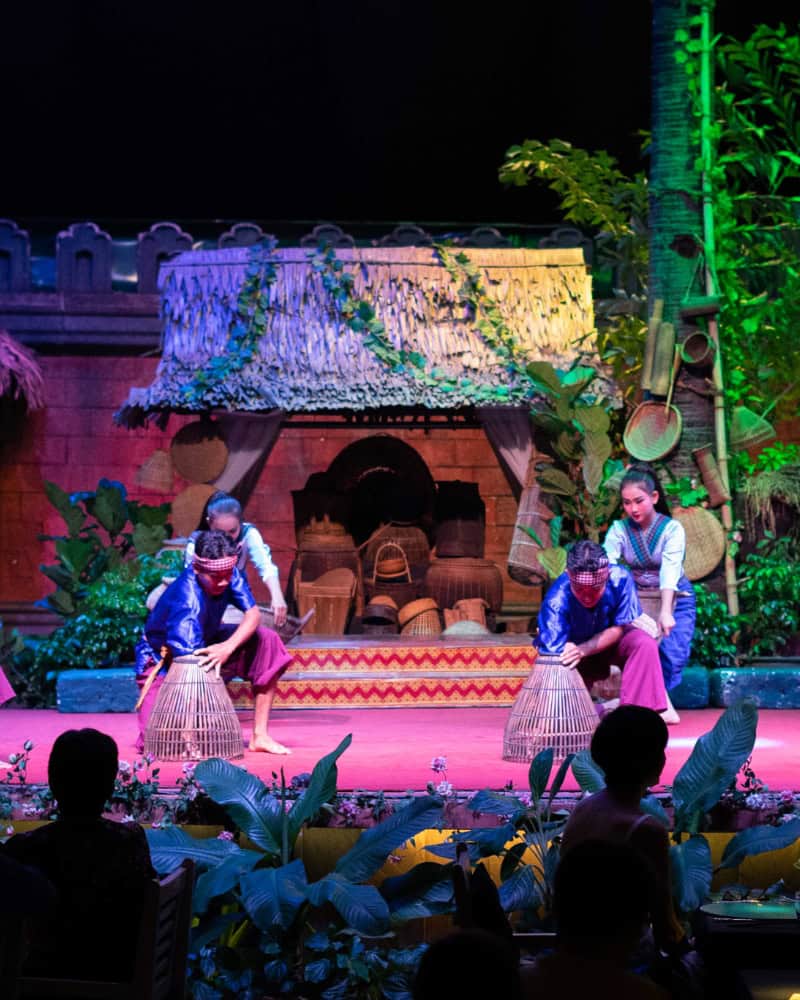
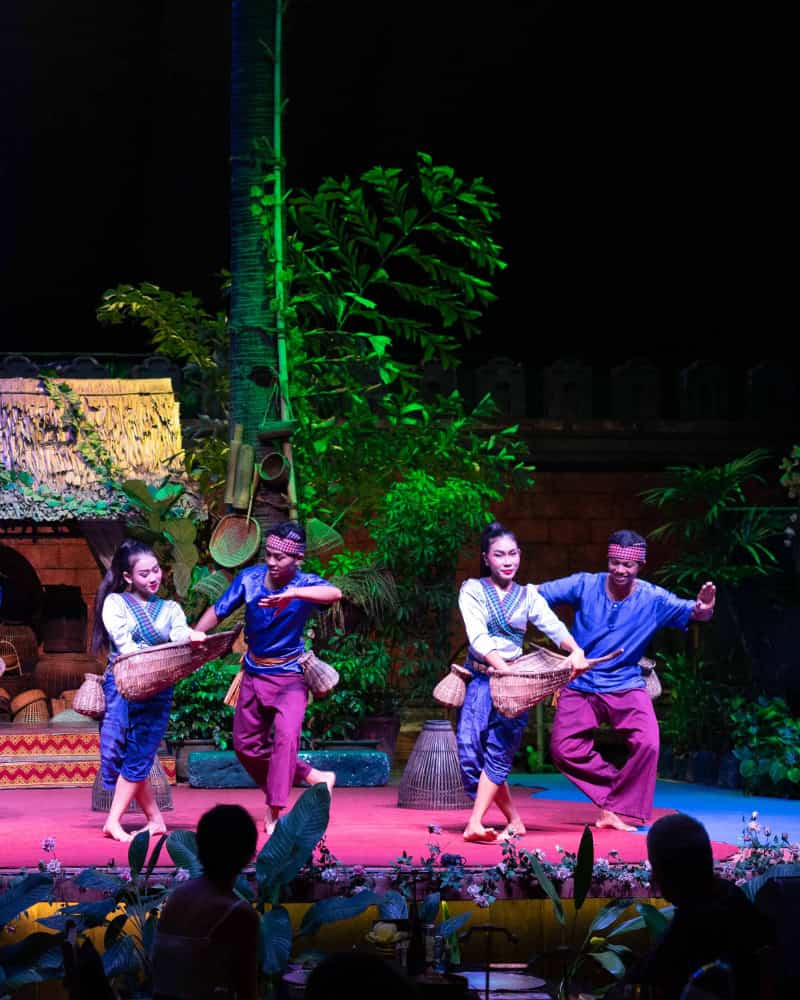
Fishing Dance

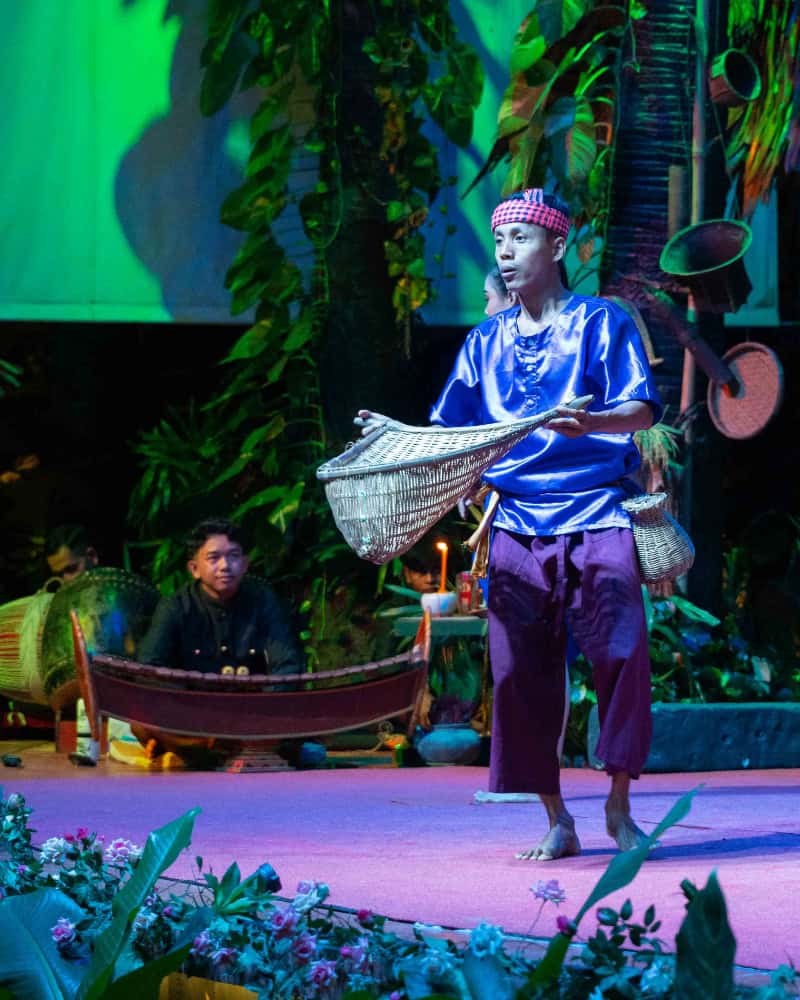
“Where there is water, there is fish”, we say this quite often in Cambodia, and it appears to be true. During the rainy season, it is common to see fishes on the road, literally crossing the road with their fins when it is very wet. The fishing dance shows an extract of what Cambodian people use to fish in lakes and waterholes like the Angrot, the basket fish trap or the Chhneang, the bamboo basket.
Kanell Show Program Bokator Demonstration
Kanell Dinner Show Bokator Interlude
VILLAGE GUARDIANS

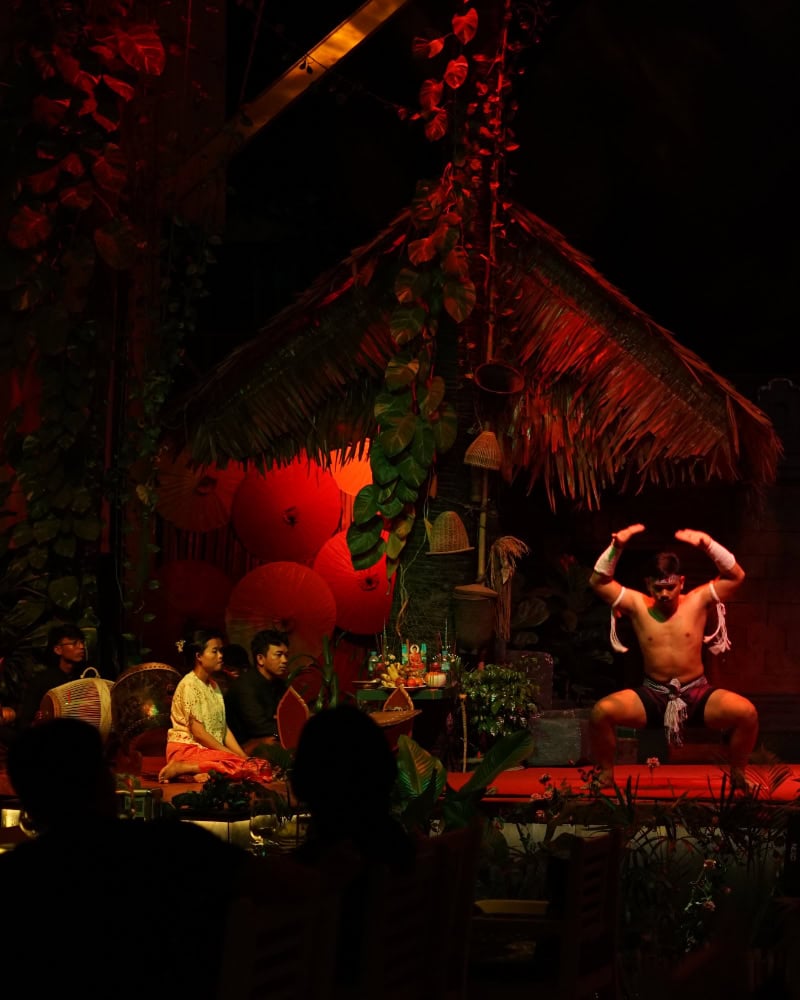
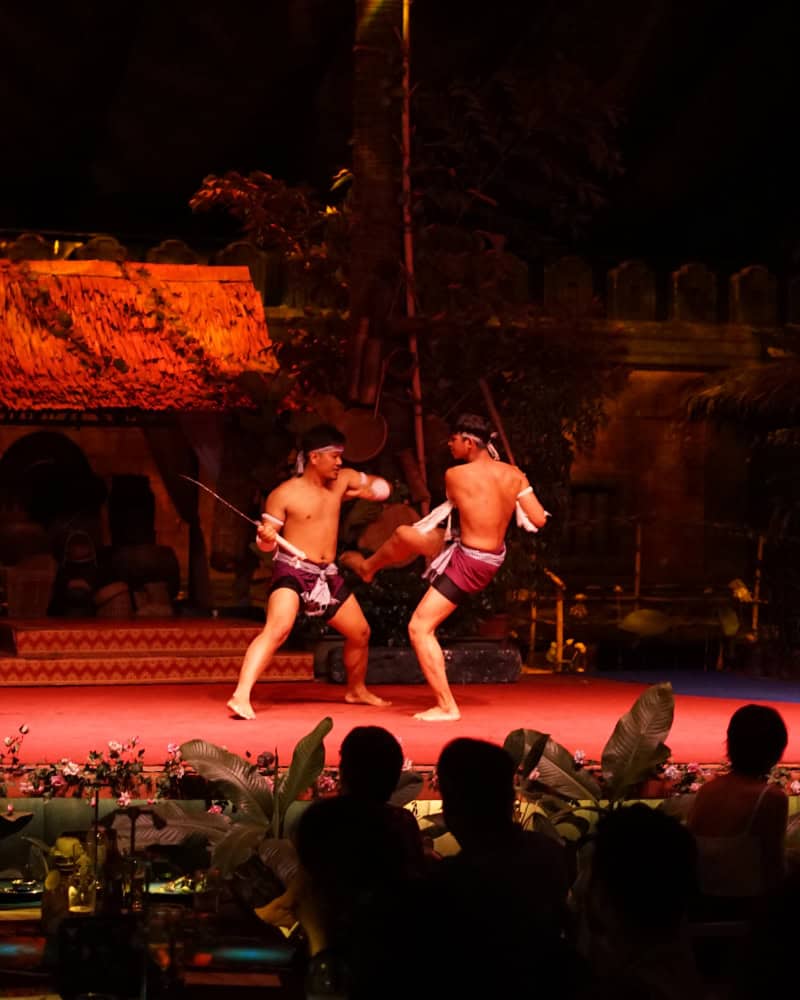
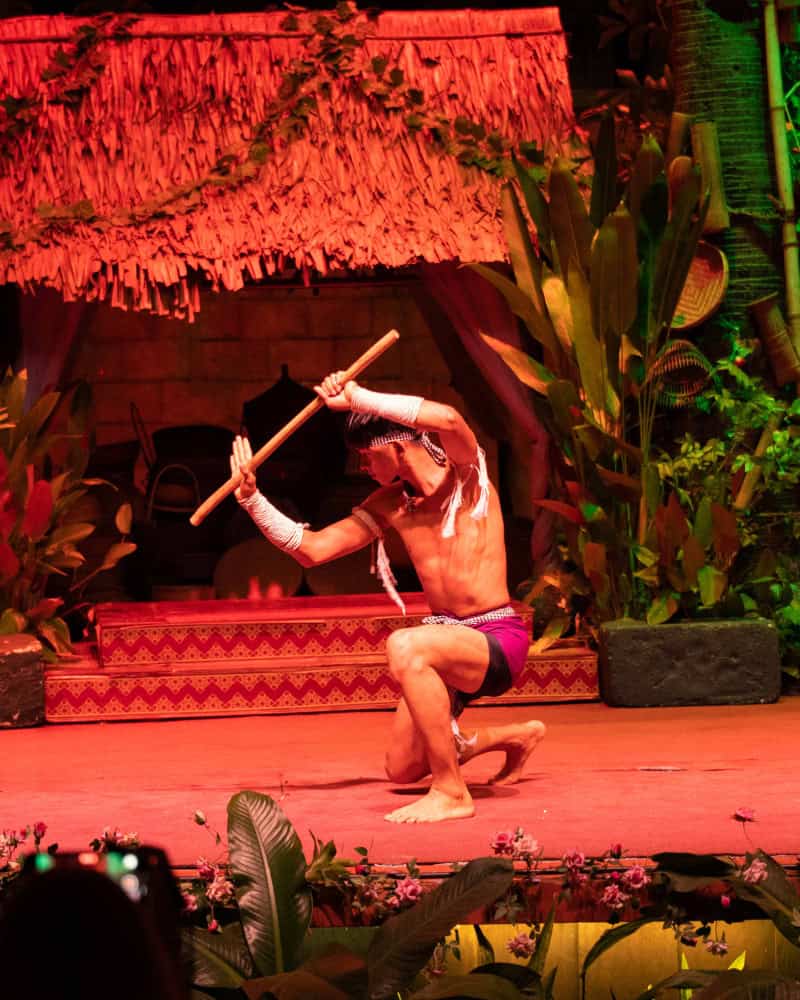
Bokator Interlude

Long stick fighting martial arts style for protecting the village.

ANCIENT COMBAT

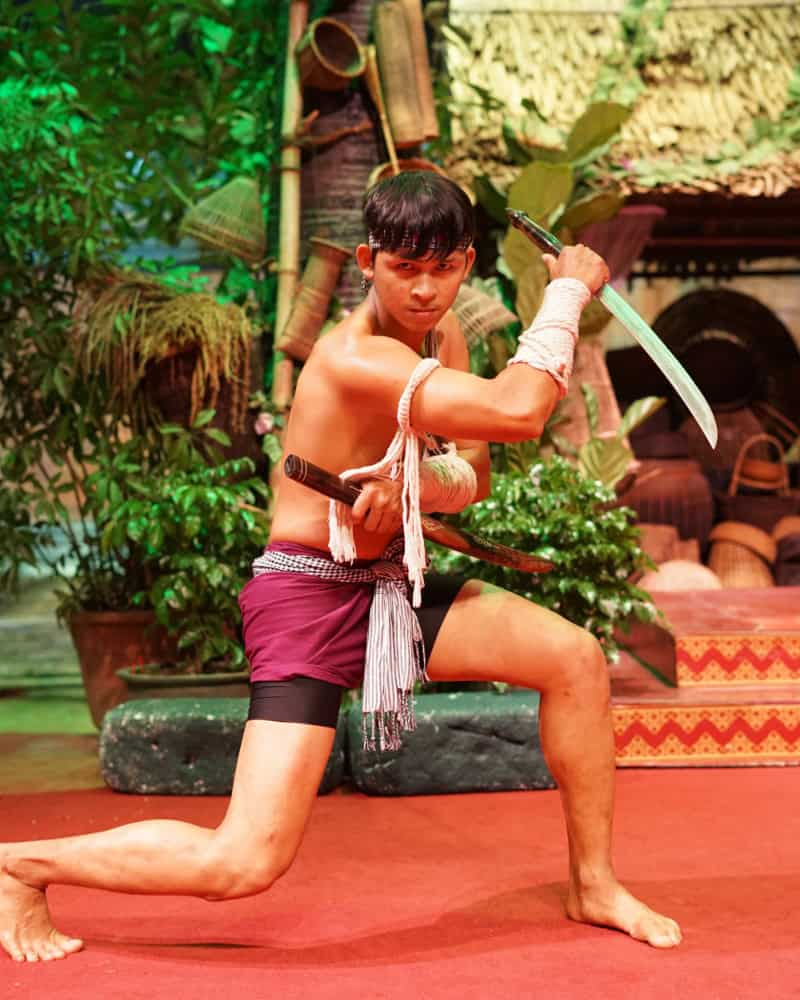
Bokator Demonstration

Experimental martial arts trails that have been learnt back in the day.
Read More
Kanell Show Program Bokator Interlude
BRIDGE OF PEACE

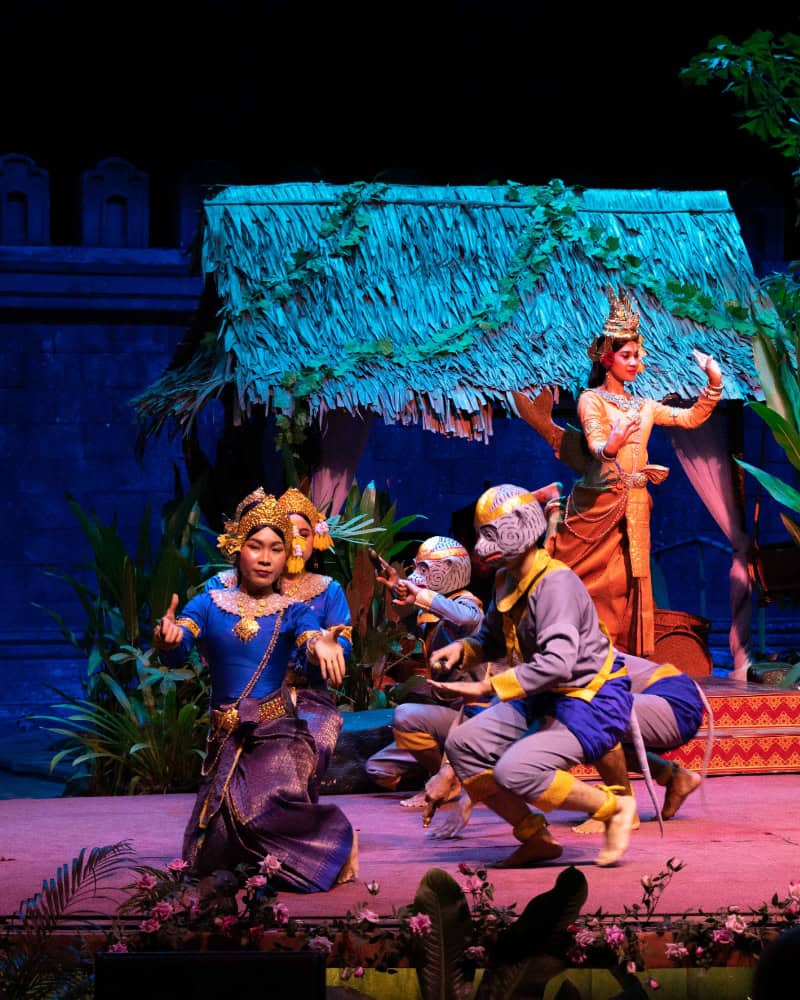
Sovann Machhar Dance and Hanuman (the monkey)

During the war between Rama and Krong Reap, Hanuman had the mission to build a bridge to Langka. But when he arrived there, the stones for using to build the bridge disappeared.

Hanuman later found out that Sovann Machhar had hidden the stones and they started a war. Later on, Hanuman and Sovann Machhar fell in love and then the peace was back.
Kanell Show Program Sovann machhar Dance and hanuman
Kanell Show Program Grasshopper Dance
Kanell Dinner Show Grasshopper Dance
COUNTRYSIDE SPIRIT

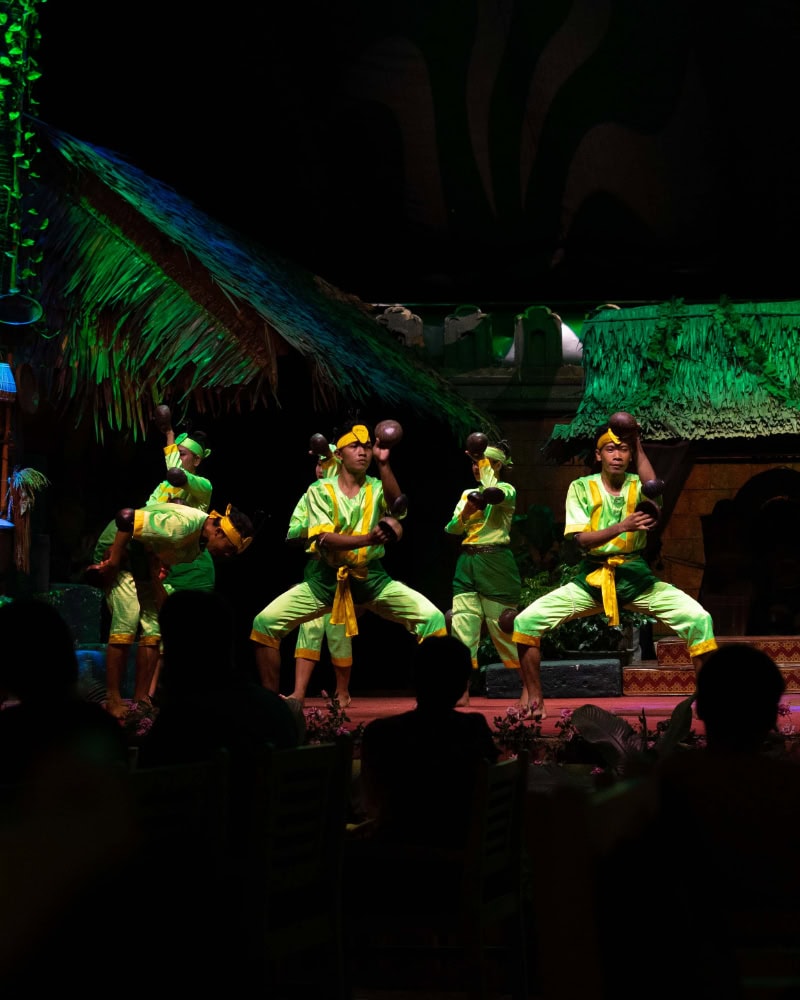
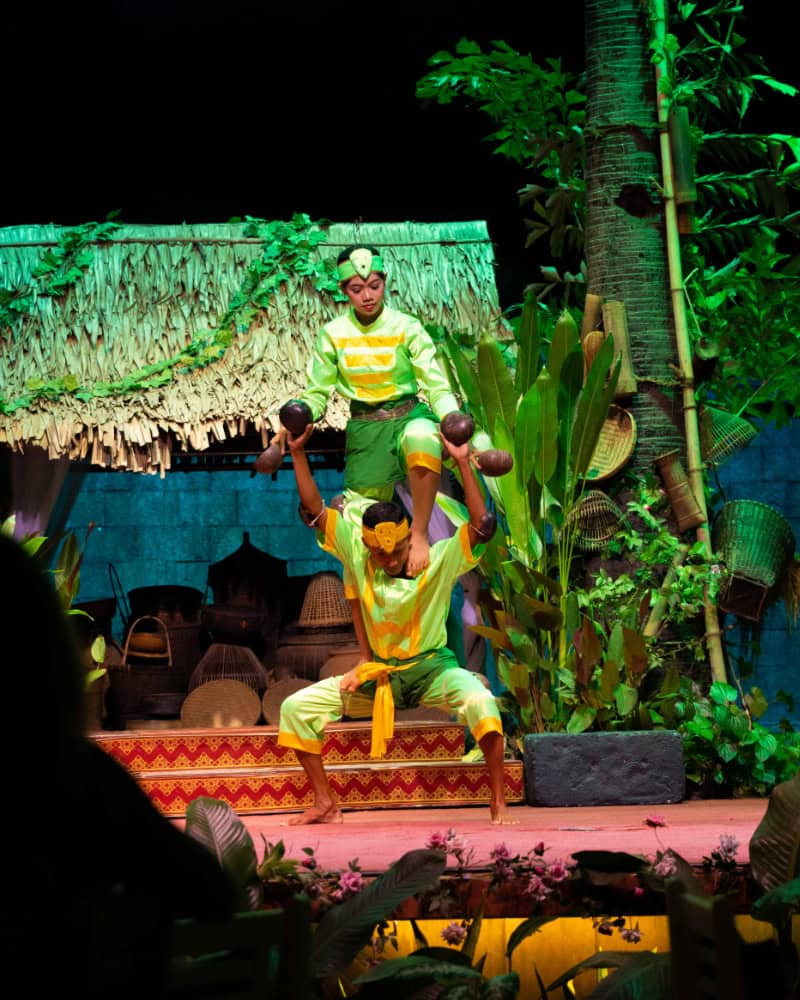
Kondob Boksrov (grasshopper Dance)

Kandob Boksrov dance take its roots in the rice field and Cambodian countryside. It represents the beauty of nature that amazes the farmers everyday while working in the rice field & observing the beautiful landscape.

All dancers wear costumes, made partially with
coconut shells that represent the Grasshopper, which can often be found in the fields. This dance pays its tribute to the beautiful nature.
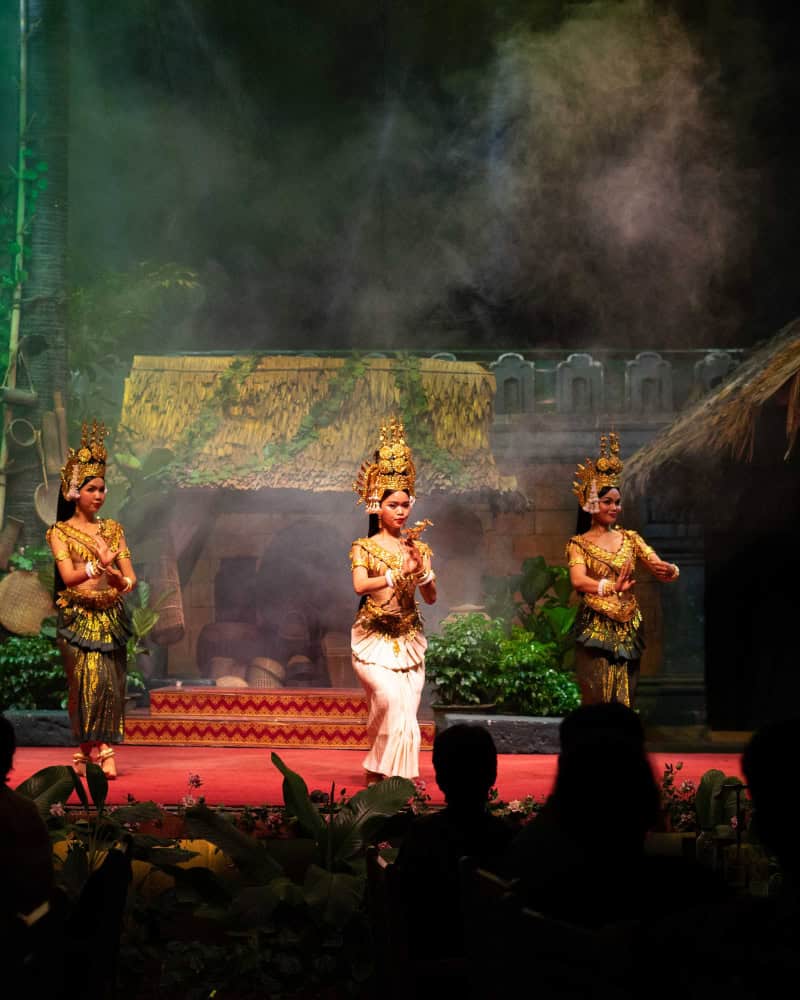
Kanell Show Program Apsara Dance
BLESSING OF GRACE

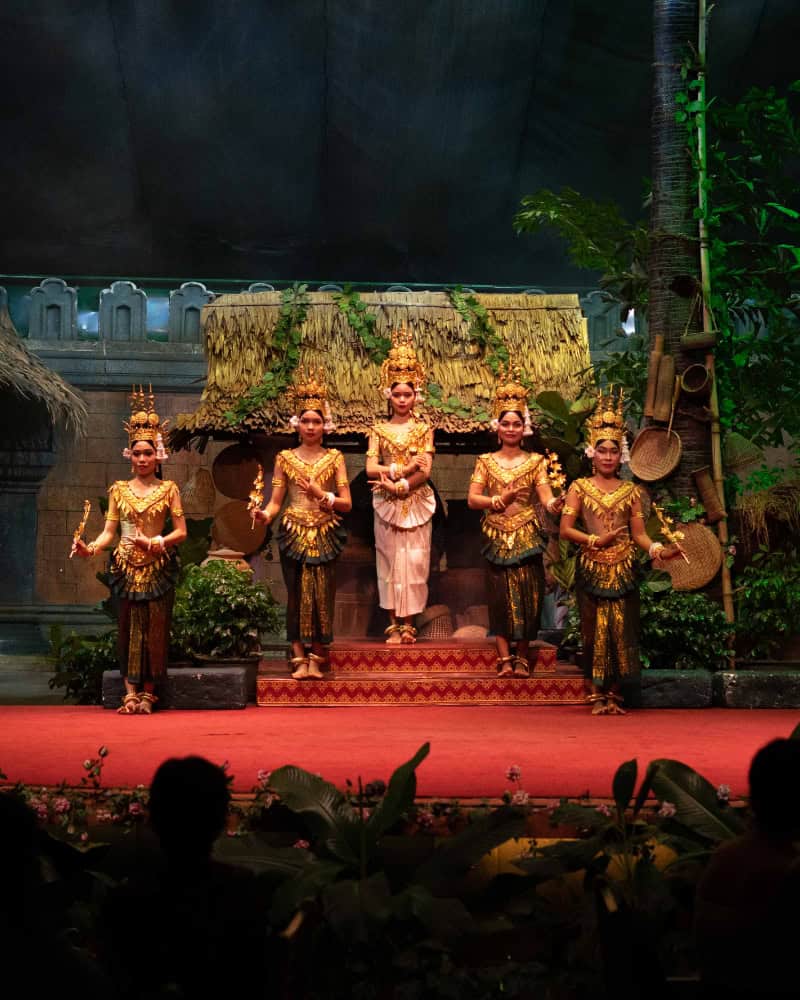
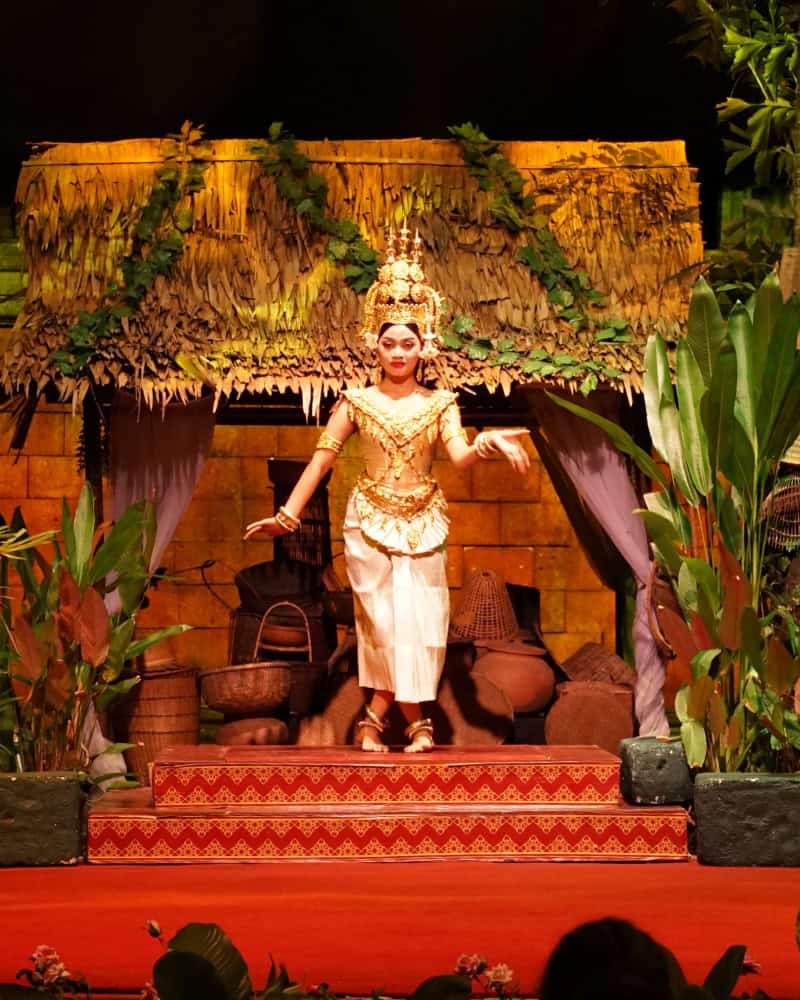
The Final Apsara Dance, the Blessing Dance

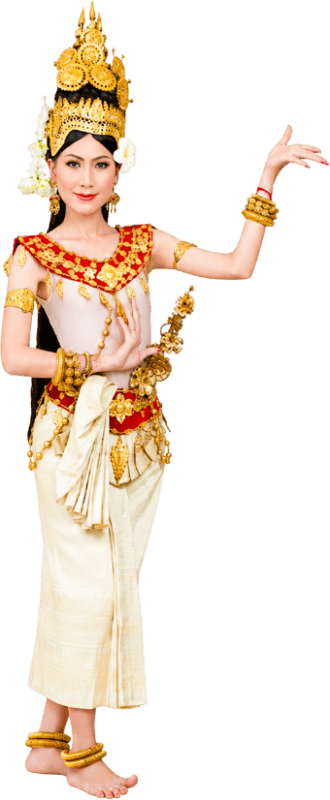
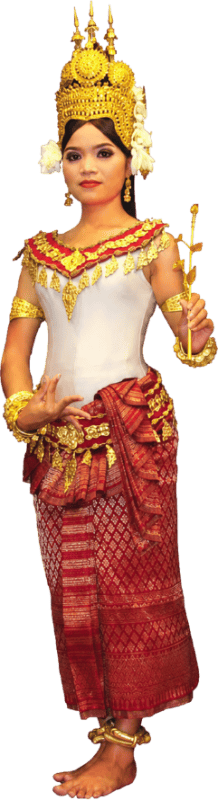
For Cambodian people, kingdom and values are defined by Pleasant, Politeness and Honesty. The dancers wear Classical Khmer Royal Ballet costumes that represent angels (Devata).

The blessing dance has been created by Her Majesty the Queen Sisowath Kosamak Nearyrath to illustrate what define Khmer values by blessing the audience in a beautiful dance.
Read More
Kanell Show Program Apsara Dance
Explore each element

Explore the Apsara Attire

Explore the details - hover/tap on each dot to uncover the story behind every element.

Leader

Apsara Leader

Korng Rak

Bangles on the left wrist

Kantrom

Bangles on the left wrist

Korng Gnor

Bangles on the right wrist

Sanlek

Bangles on the right wrist

Sangva

Loosely decorated band of beads worn

Skirt (Sbai)

Gold ankle jewelry on the Shap

Charabob

Skirt

Korng Toing Chhuk

Gold ankle jewelry on the right

Subordinate

Apsara Subordinate

Mekot

Crown

Lbak Pka Somyong

Decorative Flower

Sarong Kor

Collar

Bagn Pat

Armlet Jewelry

Charabob

Skirt

Korng Gnor / Kirvel

Gold ankle jewelry on the right
Learn more about

Bokator

“KHMER BOKATOR”

Bokator, formally called Labokkatao, is a Cambodian martial art that includes close hand-to-hand combat, ground techniques and weapons. It is known to be the oldest existing fighting system in Cambodia. This traditional sport indicates that bokator is an early form of what was the close quarter combat system used by the armies of Angkor 1000 years ago.

The term bokator is translated as “fighting like a lion”: ‘Bok’ means ‘fight’ and ‘Tor’ meaning ‘lion’.

Bokator was designed to be used on the battlefield. It uses a diverse array of elbow and knee strikes, kicks, submissions and ground fighting. Practitioners are trained to strike with knees, hands, elbows, feet and head. Even the shoulders, hip, jaw and fingers can be used in fighting an opponent to submission or death. Bokator contains hundreds of set. Like many other Asian martial arts, sets are based on the study of life and nature, such as the styles of horses, birds, eagles, and cranes. Each style contains several techniques. Weapons such as long bamboo sticks and short sticks are also formally used in Bokator.

Fighters wear the uniforms of ancient Khmer armies. A krama (scarf) is folded around their waist while blue and red silk cords, called Sangvar are tied around the combatant’s head.

Learn more about

Apsara Dances

“APSARA DANCE”

The APSARA, a nature spirit, isplayed by a woman sewn into tight fitting traditional dress, whose graceful sinuous gestures are codified to be related to classical myths or religious stories. In 2003, UNESCO declared the dance as “Masterpiece of Oral and Intangible culture’’, and laid plans for a regeneration of the art form. The performance was first introduced to the foreign countries during the 1960s, when it became known in the English Language as the Khmer or (Cambodian) Royal Ballet. Actually, the firrst Royal Ballerina was Norodom Bopha Devi, the daughter of King Norodom Sihanouk. Lkhaon Kbach Boran is the main genre of classical dance drama performed by women and Lkhaon Khao is the genre of dance performed by women.

TRADITIONAL APSARA DANCE COSTUMES

For the traditional Apsara dance (Robam Apsara) ,the costumes of the leader and subordinate roles are quite similar in styles but differ in some details. The lead dancer will be in white, a sign of heavenliness/purity, and slightly have more elaborate jewelries, such as the heightened headpiece. The number of points on the headpiece are said to represent the period of Angkor Wat. Indeed, throughout the temple, you will find similar images of Apsaras carved into the stones.

As an additional note, when performed for Royalty, the costumes substly differ from those worn at regular public performances, following a strict color code and decoration.

Apsara Sangva Pich
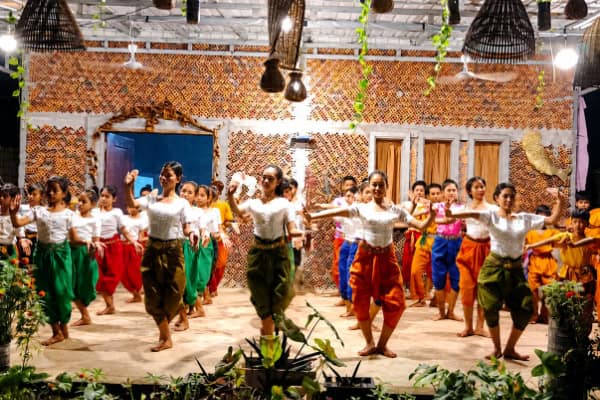
Our artists are part of our family, and we are proud to work with a social enterprise to help integrate disadvantaged young Cambodians.
Learn more about

Traditional Khmer Musical Instruments

Pinpeat Orchestra

A traditional orchestra is composed of xylophones, drums, oboes, gongs and other musical instruments.
Samphor and Skor Drums

“SAMPHOR & SKOR” DRUMS

Two large bass with buƥalo skin heads are that are struck with wooden beaters. The drums give two distinct pitches, one sounds tighter and louder, while the other one is looser and flatter.

Khloy Flute

“KHLOY” FLUTE

Khloy is an end-blown flute that can be crafted from bamboo, plastic or metal. It is widely used to ccompany the Pin Peat Orchestra, the Mahori Orchestra, Pleng Kar (Wedding Orchestra) or as a solo instrument. Khloy is one of Cambodia’s oldest instruments and has been found in stone inscriptions from the early 7th century.

Kong Vong the Circle of Gongs

“KONG VONG” THE CIRCLE OF GONGS

Kong Vong are bossed gong chimes placed on circular rattan frames. Each gong is made of bronze and varies in size. The player sits in the middle of the frame with the gongs arranged from the lowest to the highest pitch (left to right).

Roneat Ek Xylophone

“RONEAT EK” XYLOPHONE

In Khmer language, “RONEAT” means xylophone and “EK” refers to “the leader or the first one”, so its combination means “the leading xylophone”. Sometimes it is referred to as the “the running xylophone.” The RONEAT EK has 21 bars made of hard wood or bamboo that are approximately 29-39cm long, 7cm wide and range from 1-1.5cm thick. Higher and lower pitches come from the thickness of the bars (thinner to thicker respectively).

Sralai OBOE

“SRALAI” OBOE

SRALAI, which was formally called “pi-shannai”, is a traditional Cambodian oboe with a quad rumple reed and a slightly bulging body. The body of SRALAI can be crafted from a variety of different materials ranging from hardwood to ivory. It is one of the most complicated instruments to play because the breathing determines the tone, and the fingering techniques can be tricky to master.